

There are figures whom history cannot fully contain within a single word, because they were broader than the category through which one tries to name them. They were not merely rulers, nor merely combatants, nor merely scholars, nor merely men of faith. They were, rather, moral presences in difficult times, human beings placed at the precise point where force could become abuse or rise, through an intimate decision, toward a higher form of responsibility.
Sultan Abd al-Qadir al-Jaza’iri belongs to that rare lineage. His life crossed war, political construction, defeat, captivity, exile and spiritual consecration, yet in each of those stations he preserved an idea that seems simple only when pronounced from the comfort of distance, although it becomes immense when it must be sustained amid fear, violence and threat. That idea is that no power deserves to be called legitimate if it does not recognise, before anything else, the dignity of human life.
For this reason, the 24 of September deserves to be proposed as the International Day of Humanist Concord, not in order to add one more commemoration to the calendar, nor to dress a distant memory in solemn language, but to offer the world a date capable of recalling that concord is not the naïve absence of conflict, but an exacting form of moral intelligence, a public discipline that makes it possible to live together without erasing differences, to protect without demanding resemblance and to exercise authority without turning it into domination.
At a time when societies are searching for renewed languages of trust, coexistence and shared responsibility, the legacy of Abd al-Qadir offers something more valuable than an abstract invocation of dialogue. It offers a precedent. And precedents, when they have been tested under the pressure of history, possess a strength that no declaration can replace, because they demonstrate that what is desirable does not belong only to the realm of aspiration, but also to the territory of what was once lived, decided and sustained by a concrete human being.
A life at the intersection of worlds
Born in 1808 near Mascara, in present-day Algeria, Abd al-Qadir came from a family deeply rooted in religious learning, spiritual tradition and inner discipline.
His formation was not only military or administrative, but also intellectual, juridical and contemplative, because in him the leadership of men could not be separated from knowledge of the self, nor could command be detached from a higher obligation before God, before the community and before his own conscience.
This spiritual root is essential to understanding his greatness. Abd al-Qadir never understood authority as a privilege intended to impose will, but as a moral burden that obliges one to order, to protect, to mediate and to preserve human dignity even when circumstances push toward hardening, revenge or the mere logic of political survival.
When France began the conquest of Algeria in 1830, Abd al-Qadir emerged as the foremost leader of Algerian resistance. From 1832 onwards, recognised as Emir by tribes and communities, he articulated a structure of command, administration and defence that allowed him to govern extensive territories, organise resources, sustain recognisable authority and negotiate with a European power from a position of political and spiritual legitimacy.
His leadership combined the intelligence of the statesman, the resolve of the combatant, the prudence of the jurist and the depth of the man of faith. In him, these dimensions were not successive masks, but one same form of public presence, because he knew that whoever governs without spirit may become a mere administrator of force, while whoever preaches without responsibility toward reality risks turning morality into ornament.
Yet his place in history does not rest solely on having resisted. Many men have confronted empires, many have organised armies and many have pronounced noble words in times of adversity. Abd al-Qadir belongs to a more uncommon category, that of those who, even in war, refused to allow war to dictate entirely the content of their soul.
His treatment of prisoners, his respect for the pledged word and his understanding of the moral limits of conflict anticipate a sensibility that today we recognise as profoundly humanitarian. At a time when the laws of war had not yet been fully codified in international instruments, his conduct revealed an intuition of extraordinary modernity, according to which the disarmed enemy ceases to be a threat and becomes, above all, a life under custody.
When his troops were unable to provide for prisoners, Abd al-Qadir preferred liberation over strategic advantage. When captive women came under his responsibility, he entrusted their care to the closest sphere of his own family. When he had to guarantee the spiritual welfare of those who did not share his faith, he maintained links with religious authorities so that they could receive assistance according to their own tradition.
None of this was diplomatic theatre. Nor was it reputational calculation. It was the coherent expression of a principle that would accompany him throughout his life, because for Abd al-Qadir conscience was not an ornament of authority, but its deepest foundation.
Damascus and the decisive hour of a legacy
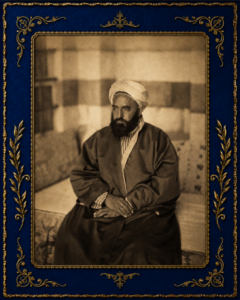 After his surrender in 1847, Abd al-Qadir was taken to France and remained in captivity until 1852. That period, which in other men might have planted resentment or closure, transformed his figure without diminishing it. The former adversary of France began to be seen, even by those who had fought against him, as a personality whose greatness exceeded the narrow logic of victory and defeat.
His subsequent settlement in Damascus opened a new chapter. There he became a scholar, a spiritual master and a notable respected by diverse communities. There he ceased to be only the leader of a defeated resistance and became a figure capable of imagining, from within his own biography, a possible reconciliation between worlds that history had placed in tension.
It was in Damascus, in 1860, that his legacy acquired a universal dimension.
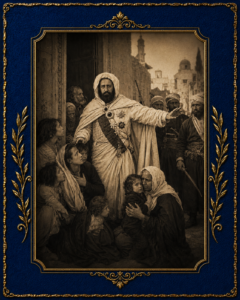
Amid sectarian violence that threatened Christian communities, Abd al-Qadir opened his homes, mobilised his followers and protected thousands of people seeking shelter. He did so without asking about the political usefulness of those vulnerable bodies, without demanding belonging, without turning protection into a currency of exchange and without confusing religious difference with an insurmountable moral distance.
Faced with the collapse of civil order, he acted not as the partisan of one community against another, but as a guardian of life. Where others saw factions, he saw human beings. Where others might have measured convenience, he heard an obligation prior to all strategy. Where the city could have become a geography of fear, he transformed residence into refuge, authority into protection and faith into responsibility toward the other.
Thousands of lives were saved, including those of members of the diplomatic community of the principal Western powers. The international response was one of rare consensus. France, the Holy See, the United States, Greece, the Ottoman Empire and other courts and governments recognised in Abd al-Qadir an exceptional form of moral courage, because they understood that his act did not belong solely to one community, one confession or one geography, but to that invisible heritage that allows humanity to recognise itself even amid its fractures.
Those recognitions were not merely ceremonial. They expressed something deeper, which was the realisation that the protection of human dignity can generate a universal language of respect even among former adversaries, different creeds and political orders that rarely coincide in admiration.
Humanist concord as a higher form of authority
In order to understand why the legacy of Abd al-Qadir naturally leads to the idea of humanist concord, it is worth pausing over the meaning of both words, because neither should be taken as a decorative formula. 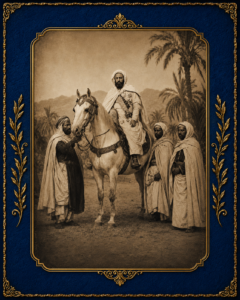
Concord is not unanimity, nor simple courtesy among those who differ, nor an artificial suspension of conflict. From ancient political reflection to the spiritual traditions that understood community as a task of the soul, concord has named something more demanding than peace understood as silence. It names a shared disposition that allows human beings to recognise one another even when they do not think alike, do not pray alike, do not obey the same memories and do not come from the same history.
Humanism, once stripped of its most comfortable rhetoric, is not a vague sympathy for humanity either. It consists in affirming that each life possesses a value that precedes its usefulness, its identity, its strength, its belonging and its convenience for power. A true humanism is tested when the person to be protected does not belong to one’s own group, when defending that person brings no immediate advantage and when saving that person may entail a cost.
For this reason, humanist concord is not a soft idea, but one of the highest forms of politics. It requires accepting that coexistence is not founded on the disappearance of differences, but on the existence of a dignity that precedes them. It requires recognising that the noblest authority is not the one that defeats everyone, but the one that knows how to stop before the sacred limit of life. It requires understanding that a civilisation does not achieve greatness through the force with which it imposes its memory, but through the generosity with which it protects those who might remain outside it.
Abd al-Qadir embodies that concord because his humanism was neither theoretical nor retrospective. It was not written after catastrophe in order to improve the narrative of the victors. It was exercised at the very moment when violence demanded adhesion, belonging demanded obedience and fear invited people to look away.
His gesture in Damascus was not only an act of individual mercy, but a political lesson on the self-limitation of power. It was the demonstration that authority can decide not to be dragged along by the passion of the majority, by the noise of the street or by the fury of one’s own. It was proof that public greatness often begins when the one who could permit harm decides to prevent it.
In that decision lies the heart of the Day of Humanist Concord. It is not a matter of celebrating a moral abstraction, but of remembering each year that there was a man formed in the Islamic tradition, recognised as sovereign by his people, adversary of a European power, captive in a foreign land and exiled in the East, who chose to protect persecuted Christians because his faith and his conscience required him to recognise in them the same dignity he defended for his own.
That is the deepest reason for the date. The 24 of September should name not only the memory of Abd al-Qadir, but the possibility of turning his legacy into a common language for governments, royal houses, international organisations, religious authorities, universities and civil society institutions seeking credible forms of dialogue between cultures.
Why the first of october and why this day
 The choice of the 24 of September as the International Day of Humanist Concord responds to the will to consecrate a date of its own in order to remember that concord between civilisations, far from being an abstract aspiration, has at certain moments in history been a concrete possibility, demonstrated by the conduct of those who knew how to place human dignity above force, belonging or convenience.
It is not a matter of adding one more commemoration to the international calendar, but of offering a moral point of reference around an idea as simple as it is demanding, according to which authority reaches its highest form when it becomes protection of human life, especially in times of crisis.
The 24 of September proposes opening each year a space for reflection, recognition and commitment around humanist concord, understood as the capacity to build bridges between communities, religions, cultures and institutions without erasing their differences, as the will to transform power into responsibility and as the decision to place human life above revenge, belonging or political convenience.
The figure of Abd al-Qadir offers the historical foundation of this commemoration, because his life demonstrated that the defence of human dignity does not belong to one civilisation, one legal tradition or one spiritual geography. Born from his Islamic formation, his inner discipline and his sense of public responsibility, his conduct achieved universal recognition precisely because it spoke a language everyone could understand, which is the language of protecting the innocent.
For this reason, the 24 of September should not be understood only as a date of homage, but as an annual invitation to renew an essential question about the way authority is exercised when, instead of dividing, it shelters, when, instead of humiliating, it recognises and when, instead of turning difference into threat, it transforms it into a possibility of coexistence.
Abd al-Qadir offers more than inspiration, because he offers a precedent.
A legacy in motion
The tribute to Sultan Abd al-Qadir, convened in Madrid under the presidency of His Royal Highness Emir Lahouari Benarba Ben Mahiedinne Al Hassani, heir to the dynastic tradition of the Algerian sovereign and president of Les Valeurs du Monde Unis, within the framework of the World Summit of Universal Values, represents an act of living diplomacy, in which the present honours the past in order to orient the future.
 The ongoing work of the Casa Al Hassani through its global initiatives, institutional dialogue, international engagement and organizations devoted to universal values, embodies a form of diplomacy rooted in continuity, responsibility and service, recalling the kind of authority that Abd al-Qadir himself came to represent, founded not only on lineage or history, but also on conduct.
The 24 of September, as the International Day of Humanist Concord, would consecrate a precedent that the world’s chancelleries, royal houses and international institutions could invoke with dignity and confidence, since it demonstrates that concord between civilisations is not a utopia, but a practice.
It demonstrates that a Muslim sovereign in the nineteenth century protected thousands of Christians in the midst of communal violence because his faith and conscience required it, that a former adversary of France was later honoured by France and that a man who had known war, captivity and exile chose protection over resentment.
This is not the comfortable humanism of declarations, but humanism tested in crisis. And it is precisely that demanding standard, which is not limited to aspiration but embodied in the lived act, that deserves a permanent place in the international calendar.
The 24 of September, the Day of Humanist Concord, should be a day not only to remember the past, but to renew a commitment to human dignity, responsible authority and dialogue between civilisations.
Federico Dalmaud Strategic Communications, Reputation and International Affairs – Spain · Ibero-America · MENA
Recent Comments